Blog : Habit :5-7
This chapter centres around the understanding of the other person – what they want, need and aspire to as well as what their motivations and mindset are.
Covey sets out in Habit 5 to change the way we interact with people by changing the way that we listen to them. We need need to be non-judgemental and not make assumptions (assume makes an ASS of of U and ME remember!).
In order to reach a Win/Win situation (See Habit 4) and be able to influence people and the outcome we need to understand the other person first. I have to admit I was a bit surprised that Covey uses the term “Influence”. To me it has sort of nasty, Machiavellian connotations; I think he really should have discussed a mutually beneficial outcome here “which he gets on to much later in the chapter” rather than jump right into the “benefits” of influencing people.
In life, we get the chance to create our own destiny. The way we view life and how we handle situations, controls the success of the relationships we create throughout our life time. Everyone has different principles, but in order to be effective we must learn to understand others. With these four important understandings, Coney teaches us lessons we should endure in order to become a great leader not just in your workplace, but also on a person level. To be proactive, think win-win, become synergistic and to sharpen the saw allows you to think about life in a different perspective and not making it only about yourself.
Midterm Vision Board
Blog 5: Habit 4: Think, Win/Win

Think Win-Win isn’t about being nice, nor is it a quick-fix technique. It is a character-based code for human interaction and collaboration. Most of us learn to base our self-worth on comparisons and competition. We think about succeeding in terms of someone else failing if I win, you lose; or if you win, I lose. Life becomes a zero-sum game. There is only so much pie to go around, and if you get a big piece, there is less for me; it’s not fair, and I’m going to make sure you don’t get anymore.
Most of us learn to base our self-worth on comparisons and competition. We think about succeeding in terms of someone else failing if I win, you lose; or if you win, I lose. Life becomes a zero-sum game. There is only so much pie to go around, and if you get a big piece, there is less for me; it’s not fair, and I’m going to make sure you don’t get anymore. Having realised how much power we actually have over our own lives (Habit 1: Be proactive), considering then what we truly wish to achieve throughout our lifetime (Habit 2: Begin with the end in mind), and then taking action (Habit 3: Putting first things first), we now come to a point where interacting with other proactive, mission focused and organised people will exponentially increase effectiveness. Covey states that in order to manage our relationships with others effectively, we need to think “Win/Win”
Think Win-Win teaches us to work together to seek mutual benefits. Most people think that if I win, you lose. But in order to become more effective we should work with people to get the power of the abilities and strengths of other people by creating Win-Win situations. With Win-Lose, or Lose-Win situations, we seem to get what we want for now, but after that, the consequences of these situations will negatively influence our relationships with others for long time. Also its helps to develop humility in you. If you rely on others for your success, then it creates a sense of humbleness that enables you to find a mutual benefit situation. Win-win makes both parties feel satisfied because they believe that neither of them is a winner nor a loser. Being high on courage and low on consideration is thinking Win/Lose. It’s having the courage of our convictions, but not being considerate about others’ convictions. Being high on consideration and low on courage is thinking Lose/Win.
Blog 4: Habit 3: Put First Things First

Habit 3: Put First Things First is the exercise of independent will toward becoming principle-centered. Habit 3 is the practical fulfillment of Habits 1 and 2. Habit 1 says, “You are the creator. You are in charge.” Habit 2 is the first mental creation, based on imagination, the ability to envision what you can become. Habit 3 is the second creation, the physical creation. This habit is where Habits 1 and 2 come together. It happens day in and day out, moment-by-moment. It deals with many of the questions addressed around time management. But that’s not all; habit 3 is about life management as well your purpose, values, roles, and priorities. What are “first things?” First things are those things you find of most worth. If you put first things first, you are organizing and managing time and events according to the personal priorities you established in Habit 2.
For me first things first means doing the most important things in life. It means being clear about your priorities
Its really important component of good personal leadership. When this habit is practised, you are considering the impact of your actions on others, remaining disciplined and retaining personal integrity. When you put last things first, you can form negative habits. also organizing and executing around your most important priorities. It is living and being driven by the principles you value most, not by the agendas and forces surrounding you.
Blog 3: Habit 2: Begin With The End In Mind
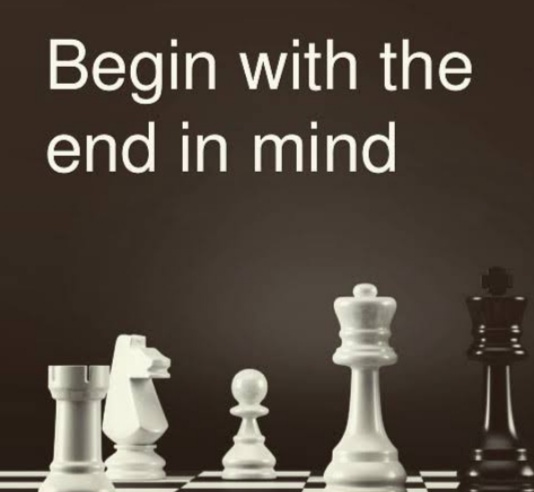
Begin With the End in Mind means to start with a clear understanding of your destination. You need to know where you are going in order to better understand where you are now so that the steps you take are always in the right direction.
Habit 2 is based on the principle that all things are created twice. There is a mental, or first creation, and a physical or second creation. Look at a business. If you want to have a successful enterprise, you must clearly define what you’re trying to accomplish. The extent to which you begin with the end in mind often determines whether or not you are able to create a successful enterprise.
I’m simple talking about thinking beyond today and deciding what direction you want to take with your life, so that each step you take is always in the right direction. You may not realize it, but you do it all the time. Beginning with the end in mind that is. So if you have plan, plan your goal and then work your plan . Begin each day with a task or goals in life with a clear vision of your desired direction and then continue by flexing your proactive muscles to make things happen . To make it clear.
Blog 2: Habit 1: Proactive
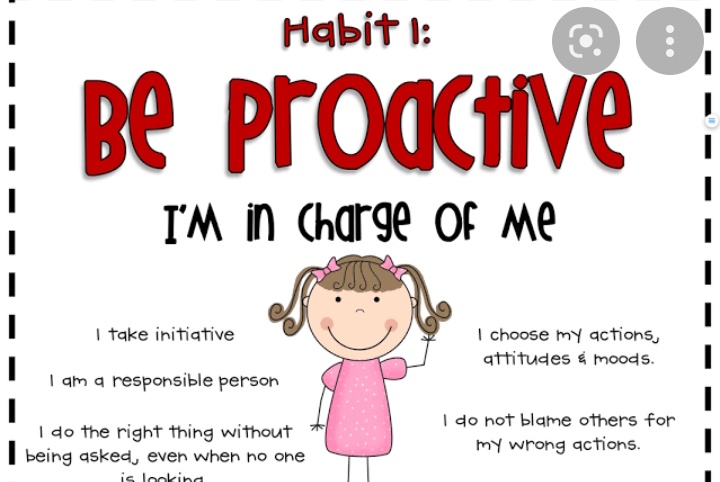
Proactive is about taking responsibility for your life. Proactive people recognize that they are “response-able.” They don’t blame circumstances, conditions, or conditioning for their behavior. They know they can choose their behavior. Reactive people, on the other hand, are often affected by their physical environment. They find external sources to blame for their behavior. If the weather is good, they feel good. If it isn’t, it affects their attitude and performance, and they blame the weather.
Covey describes how a proactive approach helps to acknowledge a mistake quickly so that instant actions can be taken to resolve it instead of waiting for it to become a more serious issue.
For me I found that I could develop my sense of proactivity by tuning in with my daily frustrations. The more I’d realize what doesn’t work around me, the more inclined I’d be to want to fix it if possible. as human beings, we are responsible for our own lives. Our behavior is a function of our decisions, not our conditions
Blog 1: Paradigms and Principles

Paradigms determine your values and behavior, which you can control, but principles determine the consequences of your behavior, which are beyond your control. Principles are universally recognized, across cultures and languages and generations
As we in paradigms and principles. We move through our daily lives, we experience a variety of emotions. An emotion is a subjective state of being that we often describe as our feelings. The words emotion and mood are sometimes used interchangeably, but psychologists use these words to refer to two different things. Typically, the word emotion indicates a subjective, affective state that is relatively intense and that occurs in response to something we experience Emotions are often thought to be consciously experienced and intentional. Mood, on the other hand, refers to a prolonged, less intense, affective state that does not occur in response to something we experience. Mood states may not be consciously recognized and do not carry the intentionality that is associated with emotion .Here we will focus on emotion, and you will learn more about mood in the chapter that covers psychological disorders.
I recently experienced a paradigm shift in my college class. I have lower grades and thinking icant do it. I had such a negtive outlook on it, I began to fail but after that I realize that failing wasn’t an option, I changed my negative paradigm to a positive paradigm. I am doing so much better to comply all my modules even it super late andim really hoping get grades. Paradigms determine our behavior by the way we think about things and if we think negative we wiill have a negative behavior, and then a negative outcome, but if we think positive we will have a positive behavior, and a positive outcome. Its all about your mindset also known as your paradigm. My personal opinion on what the statemeent means is working on your paradigms wont only change your behavior but it will also make a huge change on your outlook on things that you felt were negative and change them to postitive.
 Site Title